
Payment settings
Configure Account Updater, CVV and AVS verification rules, Direct Debit Retries, and duplicate billing information prevention from Recurly's Payment Settings page.
Account Updater requires an additional cost. Contact [email protected] or your Recurly account manager for pricing details.
Prerequisites
AVS and CVV rejection rules
- A gateway that supports returning AVS and CVV results on initial transactions
Account Updater
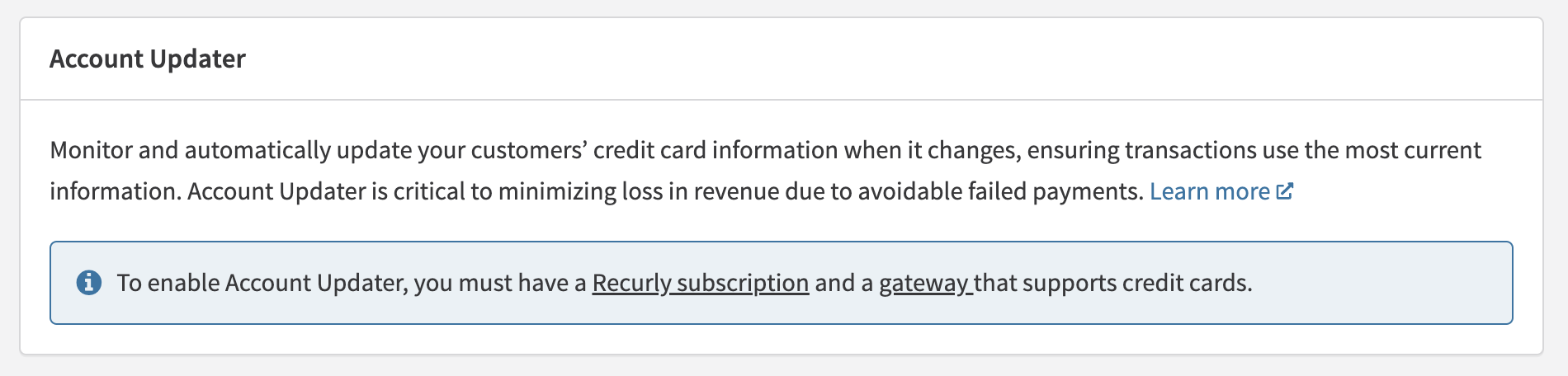
- A gateway that supports credit card payments
- An active Recurly subscription
Limitations
AVS and CVV rejection rules
- Gateways that do not return AVS or CVV results will not work with this feature
- Only certain gateways are supported: Adyen, Authorize.net, Chase Orbital, PayPal Complete, Stripe, and TSYS. Cybersource's AVS rules are located on the gateway configuration page.
- Applicable to credit card payments only
Account Updater
- Applicable to credit card payments only
- OptBlue Amex MIDs are not supported
- Merchants outside the US using Amex will not be able to use Card Refresher
Mandate Revocation Settings
- Applicable to mandated-payment methods only
- Gateways supported: Ebanx, Stripe, PayPal Complete
Definition
Key benefits
Key details
Industry examples — AVS and CVV rules
To illustrate how AVS, CVV, and Account Updater work in practice:
| Industry | Best practices |
| Streaming media, eLearning, and digital publishing | Account Updater: For recurring transactions, cardholder data can become stale for long-running accounts. Account Updater refreshes billing information to ensure subscriptions continue running over time. AVS and CVV rules: For initial sign-ups, reject fraudulent transactions where the billing address or CVV provided doesn't match the issuer's data. |
Enabling Account Updater
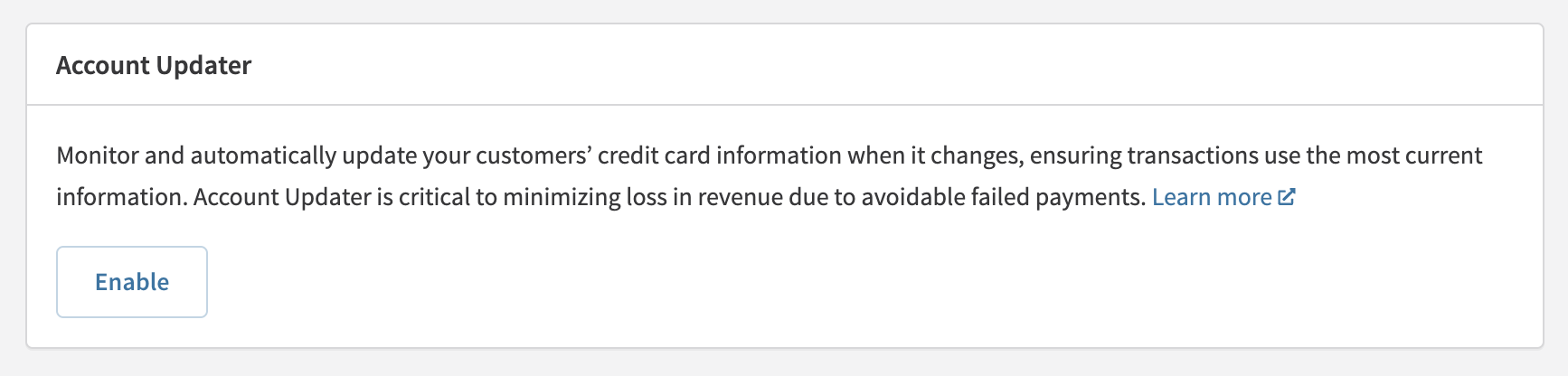
To learn more about Account Updater, see the dedicated Account Updater page.
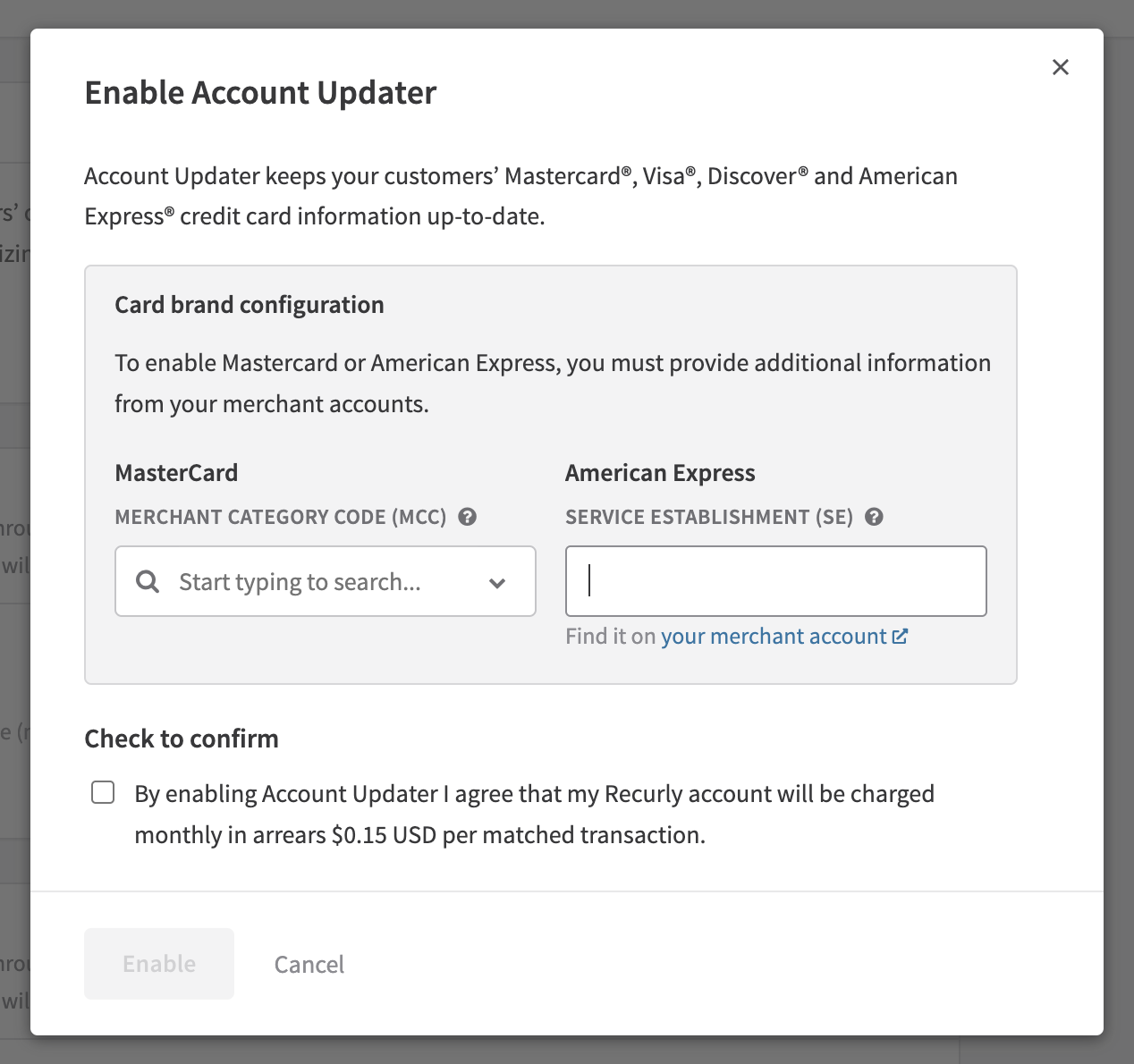
- Mastercard — Account Updater requires your Merchant Category Code (MCC) to enroll. Your MCC is a four-digit code that describes your business type (for example, 5942 for Book Stores).
- American Express — If you have a direct Amex account and want to enable Account Updater for Amex cards, provide your SE (Service Establishment) Number. OptBlue accounts are not supported.
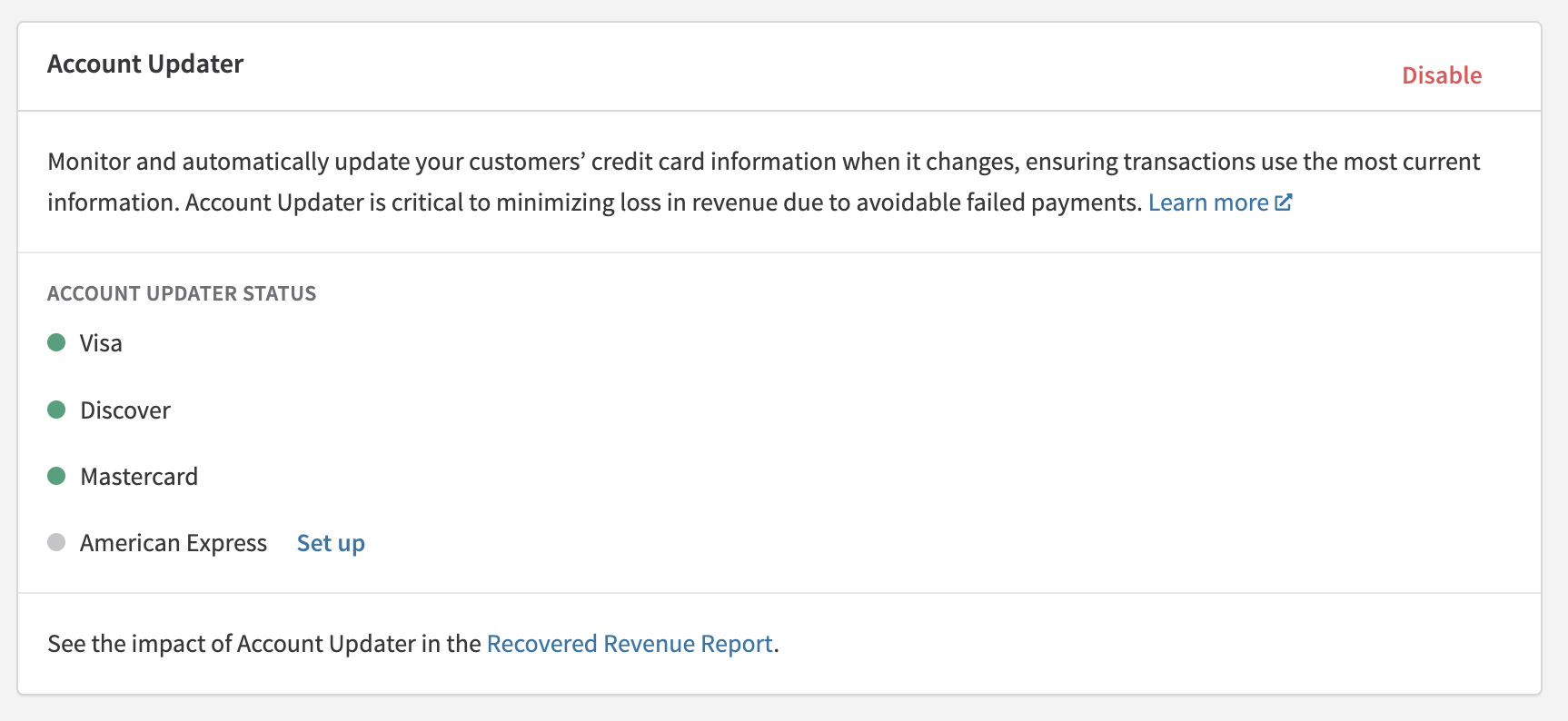
If you choose not to enter this information, only Visa and Discover will be enrolled.
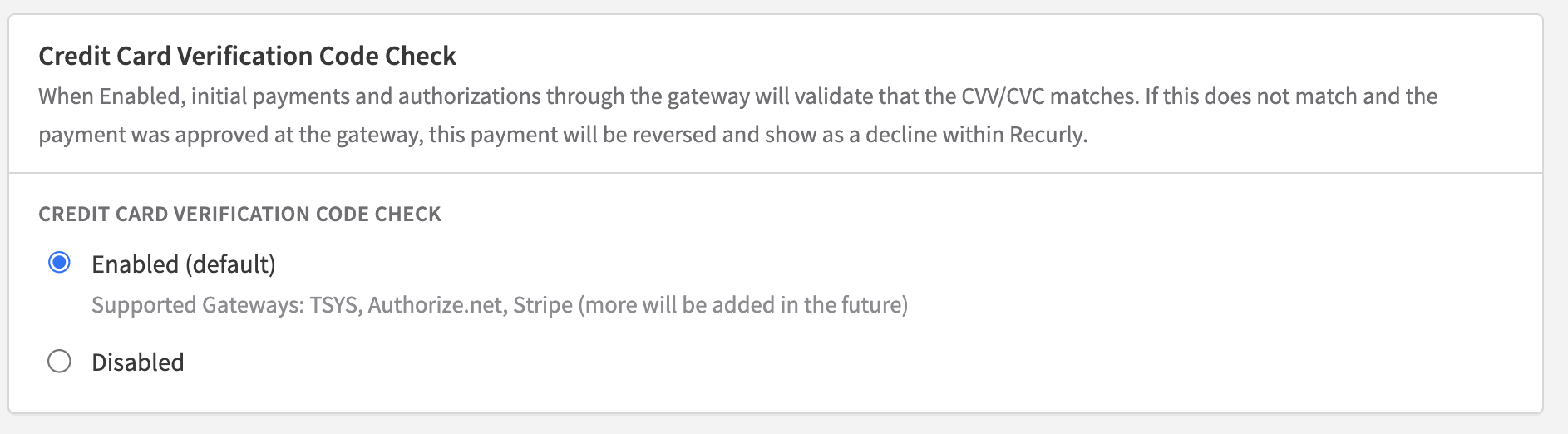
Enabling CVV checks
When Recurly sends a CVV to the cardholder's bank, the bank responds with a match or mismatch based on what it has on file. Enabling CVV checks causes Recurly to void approved transactions where the CVV doesn't match.
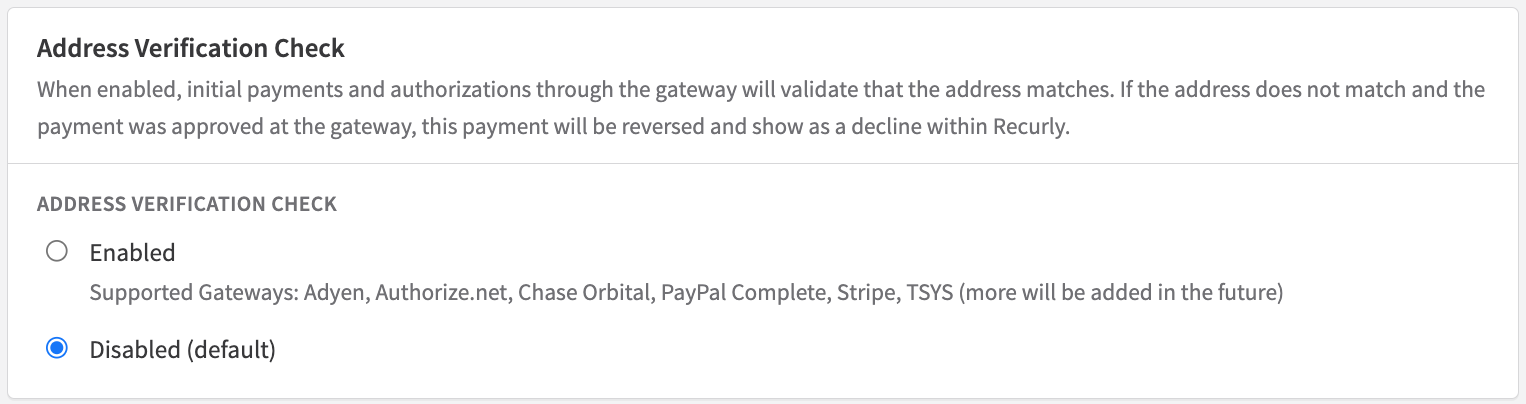
Enabling AVS checks
When Recurly sends a billing address (street number and postal code) to the cardholder's bank, the bank responds with a full match, partial match, or full mismatch. Enabling AVS checks causes Recurly to void approved transactions that receive a full mismatch response.
Duplicate billing information prevention
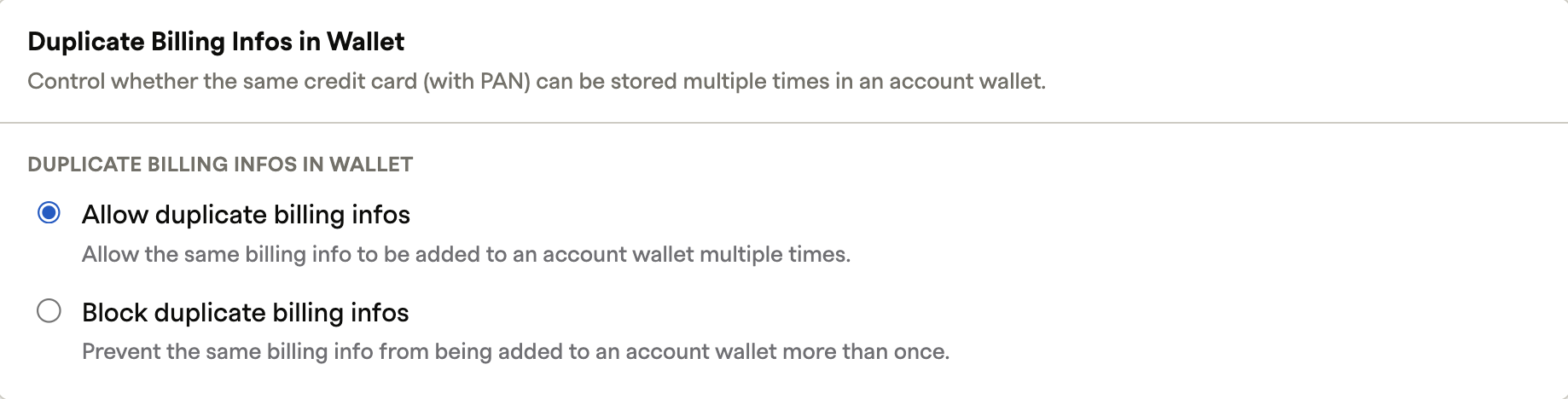
When the Wallet feature is enabled, an additional payment setting becomes available to prevent duplicate billing information from being saved to your account. This control applies to credit cards (with PANs) and RJS tokens.
By default, the setting is configured to allow duplicates. When set to block duplicates, any attempt to save a duplicate entry returns an error — both in the Recurly UI and via the billing infos API.
Direct Debit Retry Enablement
When you have a supported gateway and payment method enabled, we will retry certain Direct Debit failures within compliant limitations. Retries for Direct Debit are only actionable on insufficient funds responses, and various regulatory bodies restrict retries to only 2 attempts after the initial decline.
You can read more on our dedicated documentation for Direct Debit retries.
Direct Debit payment methods include:
- ACH
- SEPA
- BACS
- BECS
Enabling Mandate Settings
There are two features to Mandate settings:
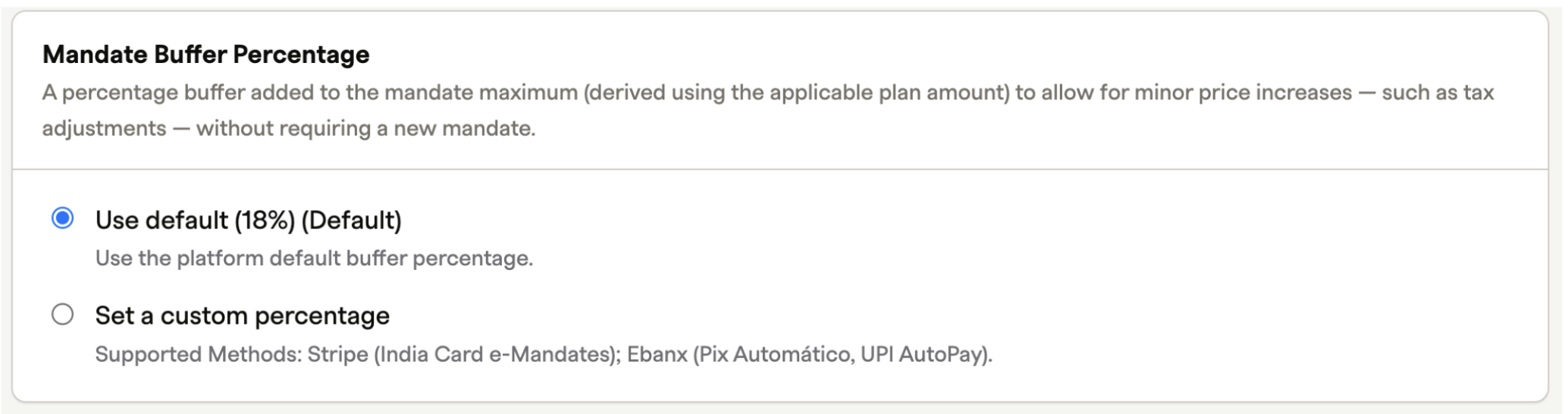
Mandate Buffer: Certain APMs require an 'upper limit' for the mandate to allow for price changes, and Recurly's default is 18% calculated off the plan amount itself. You may use this setting to customize the percentage of the buffer based on your business's specific requirements.
Keep in mind, the upper limit of a mandate is visible to your consumer in their banking apps, and as such it is not recommended to make the buffer percentage too high as this can cause cart abandonment. No higher than 30% is recommended.
It is also not recommended to go lower than 15%, as this gives you very little wiggle room if you want to make minor price changes. For example, a buffer of 15% on a $10.00 plan only nets you a 11.50 mandate upper limit, only allowing you to modify your prices a teeny bit.
- Supported Gateways: Ebanx, Stripe (India e-mandates)
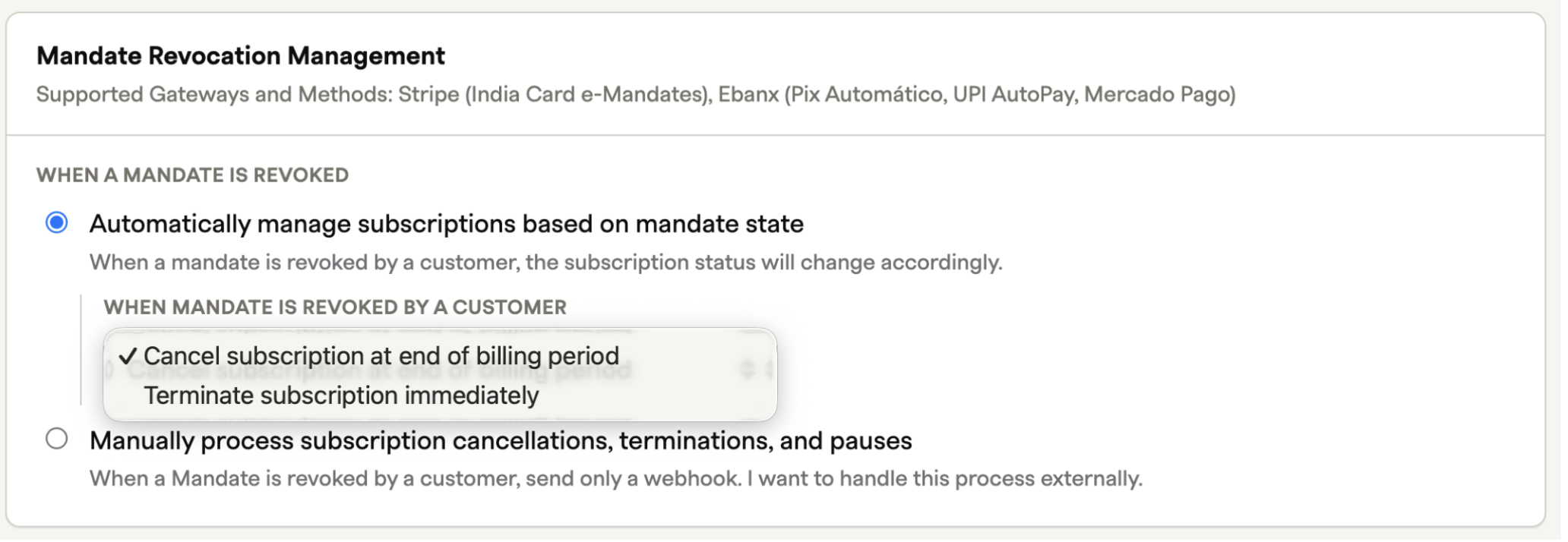
Mandate Revocation handling: When Recurly has a mandate on file, that mandate also exists at a bank-level, and for certain APMs, customers can revoke their mandates through a banking app. Supported methods include: UPI AutoPay, Cards in India using e-mandates (Stripe only), Pix Automatico, Mercado Pago.
- Supported Gateways: Ebanx, Stripe (India e-mandates)
Choose Automated Subscription handling or Manual handling
The default will be automatic management, and you are given a choice to auto-cancel or auto-expire subscriptions if a customer cancels their mandate externally. If you are listening to the mandate.inactive subscription webhook, you may choose to change to manual handling. With manual management, Recurly will not cancel or expire subscriptions upon mandate revocation, and you must take action on your own by calling our APIs to change subscription states to cancelled or expired.
FAQs
What if my customer doesn't provide an address on the initial transaction?
Your gateway will still generate an AVS response code — and without address data, the result will likely be a rejection. To avoid a spike in declines when AVS checks are enabled, make sure your checkout flow captures billing information for all transactions.
Does Account Updater work on bank account details?
No. Account Updater is exclusively for credit card payment methods and is not needed if you don't accept credit cards.
Will CVV be checked on recurring transactions?
No. Recurly doesn't store CVV codes in order to comply with PCI standards, so the CVV is never included in recurring transactions. Both AVS and CVV rules apply only to initial transactions — for example, a customer's first sign-up.
If I set my mandate buffer to 0%, can I raise my prices later?
No. External mandates with specific APMs will decline transaction requests if they exceed the mandate upper limit applied at the start of the subscription. If you have set your mandate buffer to 0%, which is not recommended, the subscription needs to be cancelled and the customer brought back into session to sign up again.
My customer revoked their mandate on a subscription and the subscription is now cancelled. Can I reactivate it?
No. External mandates that have been revoked will remain in that state. Customers will need to come back into session to sign up for a subscription again, as the mandate is no longer valid with the bank and transaction attempts against it will fail.
Updated 29 days ago